THE PACKAGING JOURNAL
What Is Frustration-Free Packaging? Benefits, Requirements & Examples
Plan a clearer opening route without losing product protection. Compare standard packaging, practical design principles and the current Amazon FFP context.
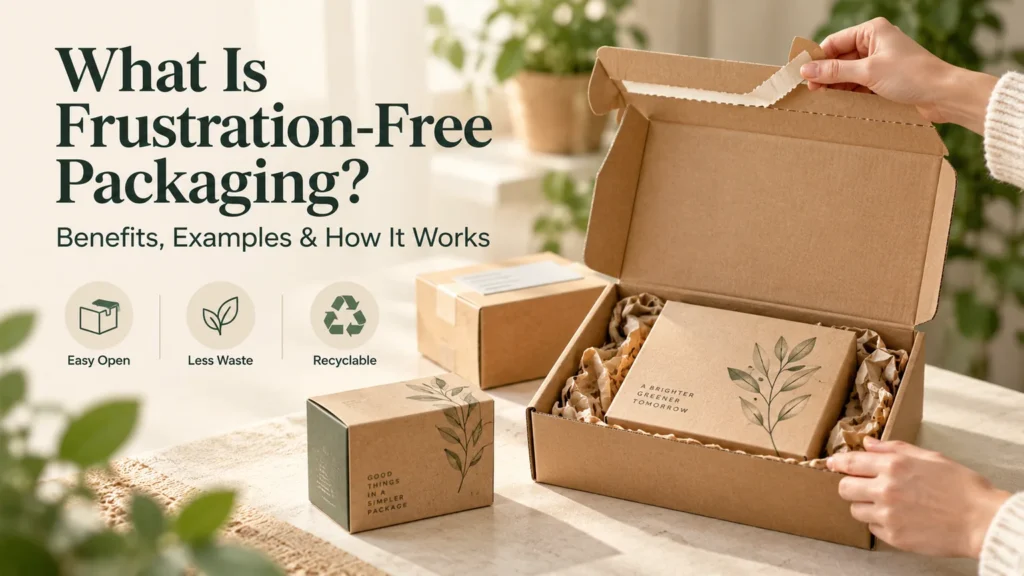
Frustration-free packaging is designed to make a product straightforward to unpack while keeping it properly protected. It favors a clear opening route, an appropriate fit and fewer unnecessary layers. The goal is to remove obstacles, not remove protection.
The phrase has two contexts. It describes a practical design approach, and Amazon uses Frustration-Free Packaging (FFP) within its packaging guidance. Those meanings should not be confused: a tear strip, brown box or easy-opening photograph does not establish Amazon program compliance.
What Is Frustration-Free Packaging?
In everyday packaging design, frustration-free means the customer can understand where to start, open the pack without fighting its components and remove the contents comfortably. A useful package also makes the next step clear: keeping an accessory, reclosing a box or separating materials for disposal.
There is no universal easy-open box style. A lightweight accessory and a fragile glass item need different structures. The design should reduce avoidable effort around the actual product, rather than applying the same closure and filler to everything.
Why Frustration-Free Packaging Exists
A product can arrive intact and still be awkward to access. Hidden tape, tightly fastened ties and several nested layers make people search for the opening. A fitted insert can also become an obstacle if there is nowhere to grip the product.
These details matter after opening, too. Loose components need collecting, different materials may need separating, and a return may require a usable closure. Planning the complete unpacking sequence helps address problems that an attractive closed-box mockup can hide.
Amazon Frustration-Free Packaging: What It Means Today
As checked on October 30, 2026, Amazon’s US Seller Central SIPP FAQ describes FFP as SIPP-compliant packaging with additional requirements. Its guidance calls for all packaging materials to be curbside recyclable under applicable regional laws and removal of all contents within 120 seconds with minimal tool use. It excludes blister packs, plastic inserts, packaging peanuts, shredded paper and welded clamshells.
Amazon states there is no separate FFP certification. Check the current product-specific SIPP guidance before making claims; choosing a material or box style is not approval. This overview is not an enrollment or testing manual.
Frustration-Free Packaging vs Standard Packaging
Standard packaging is a broad category, not a synonym for poor design. It may already be easy to open and well fitted. The comparison is about priorities and the finished result.
| Consideration | Standard packaging | Frustration-free approach |
|---|---|---|
| Opening | Depends on the closure and layout. | Makes the opening route deliberate and clear. |
| Components | May use several layers or fasteners. | Questions each component’s purpose. |
| Protection | Must suit the product and journey. | Keeps that requirement while simplifying access. |
| Sizing | Can be stock or custom fitted. | Controls unused space without crowding contents. |
| Disposal | Depends on the complete construction. | Considers separation and clear instructions. |
| Branding | Can support printed graphics. | Can also carry branding without obstructing opening. |
| Amazon status | No status follows from the name alone. | Specific claims need current program evidence. |
Core Principles of an Easy-Open Pack
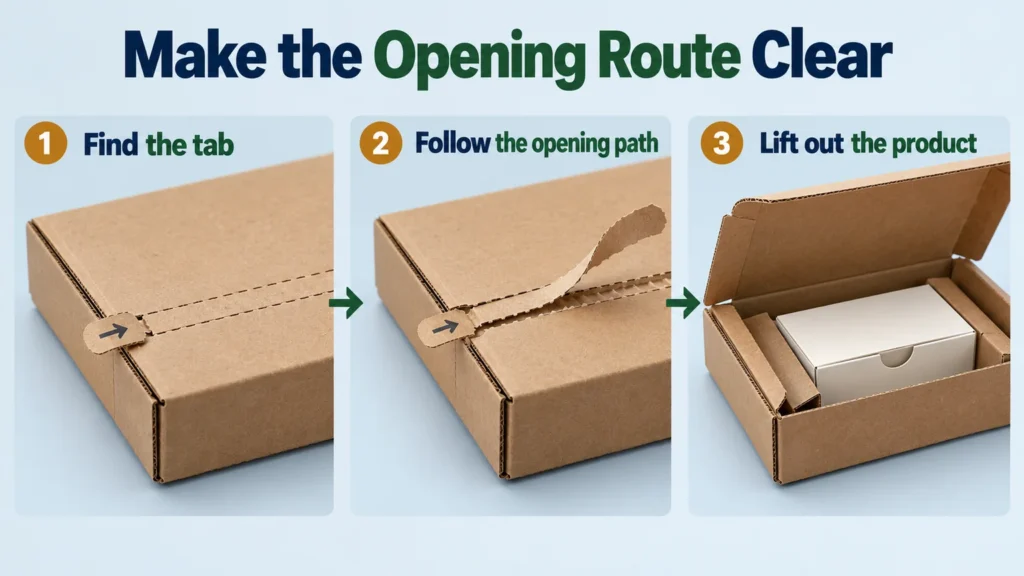
Make the starting point visible. A pull tab, finger notch or short instruction should help the customer identify the intended action. Check grip and access rather than assuming a small tab is obvious.
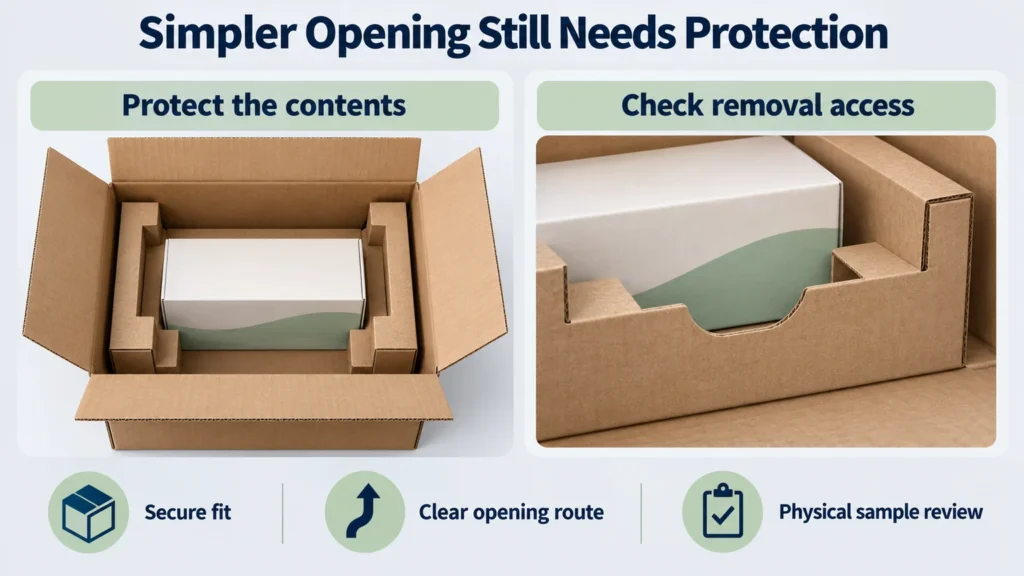
Keep protection purposeful. Supports should control movement and protect vulnerable areas. Give the customer a way to remove the item without tipping the whole box or pulling on a delicate part.
Simplify the sequence. Remove redundant layers, not useful functions. For example, one fitted support may organize accessories better than separate wraps, but its actual performance still needs assessment.
Materials and Box Styles That Can Support the Goal
Mailer boxes can offer a clear lid-and-flap opening sequence. A tear strip is another design option to discuss, not a feature to assume every structure includes. The closure must stay secure until the customer uses it.
Corrugated boxes provide structural options for shipping. Kraft paper, paperboard supports and other paper-based components may fit a simpler design, depending on the contents. Material appearance alone establishes neither protection nor recovery suitability.
For a broader view of outer packs, product cartons and inserts, see our ecommerce packaging guide. Here, the focus is the customer’s opening sequence within that complete system.
Benefits for Brands and Customers
A straightforward sequence helps customers find the product and its accessories without unnecessary searching. Fewer redundant parts can make packing and unpacking simpler, while clear separation instructions can make disposal decisions easier.
These are design objectives to evaluate, not guaranteed savings. A new closure or support can change production and packing costs. Compare the complete pack and workflow before assuming that fewer pieces mean a cheaper job or fewer returns.
Trade-Offs: When Simpler Is Not Enough
Fragile contents may need cushioning and separation that should not be removed for appearance. Tamper evidence may also be necessary. Where child-resistant or other product-specific controls apply, preserve those functions rather than treating easy opening as the only priority.
Consider what happens after a tear strip is removed. If the customer may return the product, the original opening mechanism might not provide a usable second closure. Check whether the pack can be reclosed or needs clear return-packing instructions.
How to Plan Frustration-Free Packaging
- Measure the packed contents. Include retail cartons, accessories and proposed supports. Distinguish inside fit from closed outer dimensions.
- Map the unpacking steps. Identify every seal, wrap and fastener. Ask what each one protects or communicates.
- Choose the opening route. Review tab access, grip, adhesive placement and whether the action is understandable.
- Check protection and removal. Support fragile areas, control movement and provide comfortable access to the contents.
- Review physical samples. Assess assembly, transit performance, opening and any return use under representative conditions.
- Verify material claims. Review coatings, adhesives, labels and inserts alongside intended collection options.
- Check marketplace requirements. If Amazon is relevant, assess the complete product-and-packaging system against its current guidance.
Common Mistakes to Avoid
Oversized boxes can create unnecessary space and filler. An undersized pack can leave no room for protection or a comfortable grip. Excess adhesive can block the intended opening, while a weak strip can tear before it completes the opening path.
Another mistake is assuming paper-looking materials are recyclable everywhere. The FTC’s Green Guides summary explains why environmental claims need support and appropriate qualifications. Our sustainable packaging guide covers the broader material trade-offs.
Keep photographs and prototypes separate from evidence of program approval. Confirm the final specification and any relevant qualification before putting a compliance claim on artwork.
Frequently Asked Questions
What does frustration-free packaging mean?
It generally means packaging designed for straightforward opening and product removal, with purposeful protection and fewer unnecessary obstacles.
What does it mean on Amazon?
Amazon uses FFP for SIPP-compliant packaging meeting additional easy-opening and material requirements. Refer to its current guidance for the actual product and market.
How is it different from standard packaging?
The approach explicitly prioritizes the unpacking sequence. Standard packaging can also be easy to open, so compare the actual design rather than the label.
Does it always ship without another box?
No. General easy-open design does not establish shipping readiness. Amazon also notes that SIPP products may be combined with other items in an outer package.
Is it always recyclable?
A general design description does not establish recyclability. Evaluate the complete construction and local collection system; specific program claims have their own requirements.
Can any custom box be made frustration-free?
Many structures can be improved, but product protection, closure, accessibility and applicable controls determine what changes are suitable. Review the finished pack, not just an empty box.
Design the Opening Around the Product
Frustration-free packaging starts with a practical question: how will someone reach the product without unnecessary effort or loss of protection? Work through that sequence, check a sample and support any material or program claims with evidence.
To discuss an easy-open custom pack, share your packaging brief with dimensions, quantity, artwork, protection needs and intended use. Include opening and return requirements so they can be considered alongside the structure.
KEEP EXPLORING