THE PACKAGING JOURNAL
Playing Card Measurements: Standard Sizes and Packaging Guide
Compare poker, bridge, tarot and mini card sizes, then learn how deck thickness, print bleed and box dimensions affect packaging fit.
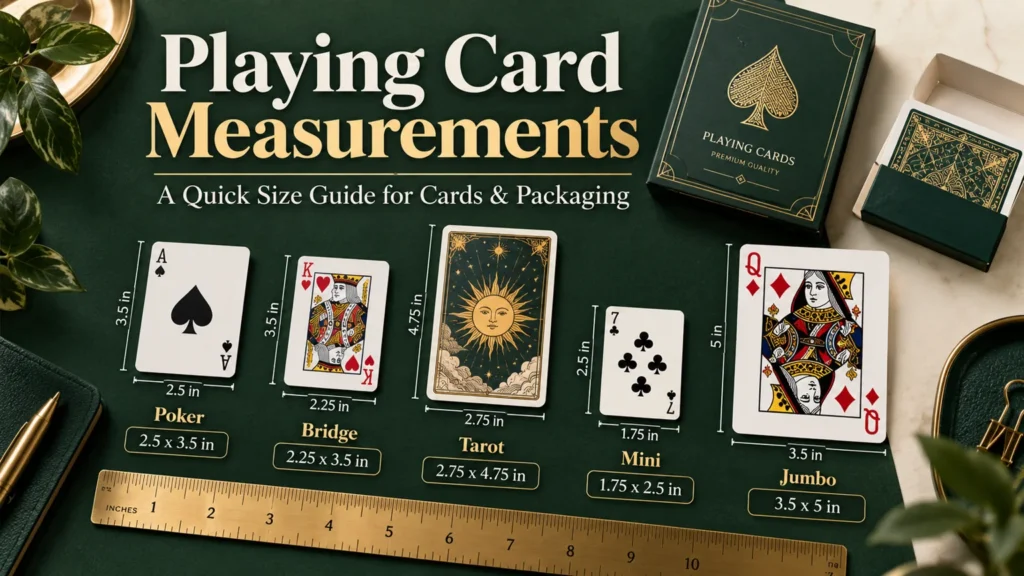
Standard poker-size playing card measurements are 2.5 × 3.5 inches (63.5 × 88.9 mm). Bridge cards measure 2.25 × 3.5 inches (57.15 × 88.9 mm): the same height, with a narrower face. Tarot, mini and jumbo formats vary by manufacturer.
Those figures describe one finished card. A complete deck also has thickness, and its packaging needs room for loading and removal. Start with the card size, then measure the actual stack before choosing a box.
Standard Playing Card Measurements at a Glance
All sizes below are width × height. Metric figures are exact conversions of the listed inches, using 25.4 mm per inch; a printer’s rounded product labels may differ.
| Card type | Inches | Millimeters | Common use |
|---|---|---|---|
| Poker | 2.5 × 3.5 | 63.5 × 88.9 | General card games |
| Bridge | 2.25 × 3.5 | 57.15 × 88.9 | Games with larger hands |
| Tarot example | 2.75 × 4.75 | 69.85 × 120.65 | Illustrated reading decks |
| Mini example | 1.75 × 2.5 | 44.45 × 63.5 | Travel and compact games |
| Jumbo example | 3.5 × 5 | 88.9 × 127 | Larger artwork and game text |
These formats are offered in MakePlayingCards’ size guide and its jumbo card range. They are reference sizes, not dimensions for a universal matching box.
What Is the Standard Size of a Playing Card?
Poker size is a useful default when someone asks for standard playing card dimensions. Still, “standard” is not a production specification. Confirm the supplier’s finished dimensions before ordering sleeves, printing artwork or approving packaging.
For playing card dimensions in centimeters, divide millimeters by ten: a poker card is 6.35 × 8.89 cm. Keep one unit system throughout the packaging brief to avoid mixing rounded measurements.
Poker Card Measurements
A poker card is 2.5 inches wide and 3.5 inches tall. Its wider face provides familiar proportions for suit symbols, illustrations and game instructions. It is a practical starting point for a conventional deck or a custom card game.
Check the finished size rather than the product name alone. A supplier may offer a slightly different format under a similar name; a close measurement is not necessarily interchangeable when a box or sleeve fits tightly.
Bridge Card Measurements
Bridge cards are 2.25 inches wide and 3.5 inches tall. The narrower width can make a larger hand easier to fan and hold. Compared with poker cards, each card is 0.25 inch (6.35 mm) narrower.
The height staying the same does not make the packaging interchangeable. A poker-width carton can leave a bridge deck moving sideways unless its structure or insert is designed to hold that narrower stack.
Tarot Card Measurements
A common tarot card size is 2.75 × 4.75 inches, equivalent to 69.85 × 120.65 mm. Its taller face provides more space for illustrations. Publishers also use pocket, oversized and custom formats, so “tarot” alone does not specify dimensions.
Include any guidebook when planning the package. A booklet beside the deck changes the layout; one placed above it changes the required depth. Neither is covered by the card’s width and height.
Mini, Jumbo and Custom Card Sizes
Mini and jumbo describe categories, not one fixed size. The featured image shows a 1.75 × 2.5-inch mini format and a 3.5 × 5-inch jumbo format. Other printers offer different dimensions under those labels.
Also distinguish a physically large card from a large printed index. Bigger corner numbers do not necessarily mean a bigger card. Ask for finished width and height, then consider whether the text remains readable and the deck comfortable to shuffle.
Poker vs Bridge Card Size: What Is the Difference?
- Width: poker is 2.5 inches; bridge is 2.25 inches.
- Height: both listed formats are 3.5 inches.
- Handling: the narrower bridge format reduces the width of a fanned hand.
- Packaging: each needs a box fitted to its actual stack, including depth.
Choose the card format before approving a tuck-box dieline. Changing the width afterward can affect panel dimensions, artwork placement and how securely the deck sits.
Card Size vs Deck Size vs Box Size
A 2.5 × 3.5-inch card does not call for a finished box with those same outside measurements. Five separate measurements matter:
- Finished card size: one trimmed card’s width and height.
- Deck size: the stack’s width, height and measured thickness.
- Internal box dimensions: usable room for the deck and other contents.
- External box dimensions: the assembled package, including its walls and structure.
- Artwork size: the print area, including any required bleed beyond trim.
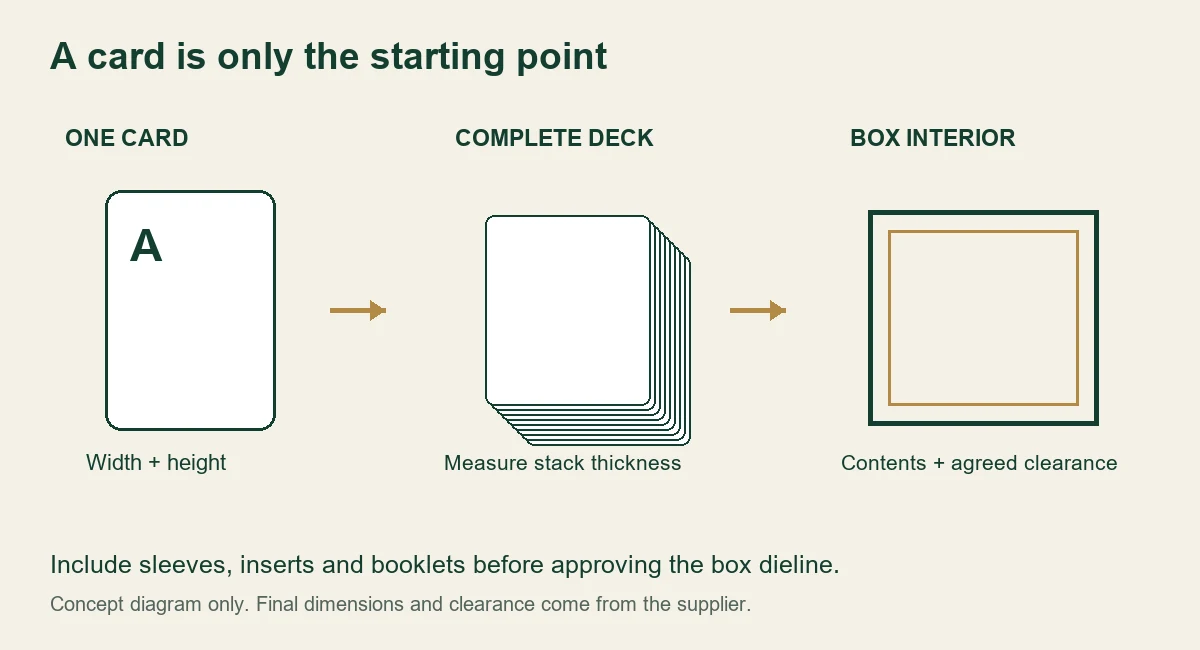
Deck thickness changes with card count, stock caliper and finish. GSM measures paper weight per area; it does not by itself establish thickness. Two decks with the same card count can therefore need different box depths.
The planning logic is simple: internal width and height allow for the cards plus appropriate loading clearance; internal depth allows for the finished stack, inserts or booklets, plus clearance. The supplier determines those allowances. There is no universal number to add.
How to Measure a Deck for a Playing Card Box
- Check width and height. Measure a finished card edge to edge, using the same units for both.
- Assemble the complete deck. Include jokers, instruction cards and promotional cards.
- Measure stack thickness. Square the deck on a flat surface. Use a caliper gently without squeezing it thinner.
- Add everything packed with it. Include sleeves, wrapping, dividers and the final folded booklet.
- Confirm the packaging specification. Send the measurements and a physical sample where possible. Approve the supplier’s dieline and test fit before production.
Record whether quoted box dimensions are internal or external. Our box measurement guide explains the distinction. A sample should let the deck slide out comfortably while keeping it from rattling around.
Playing Card Printing: Trim, Bleed and Safe Area
Trim is the finished cut edge. Bleed extends background artwork beyond it so small cutting shifts do not leave white edges. The safe area sits inside trim and keeps essential text and symbols away from the cut.
If a printer requests 0.125 inch of bleed on every side, a 2.5 × 3.5-inch card needs artwork extending to 2.75 × 3.75 inches. The finished card remains 2.5 × 3.5 inches. Here, 0.125 inch equals 3.175 mm, often described approximately as 3 mm.
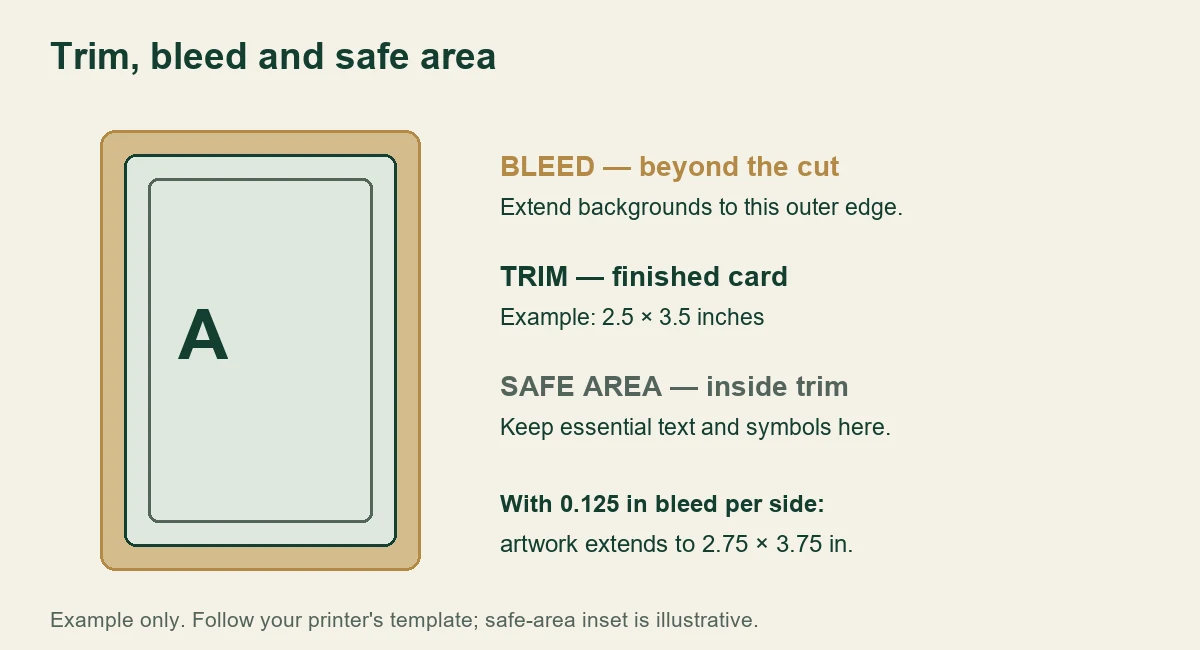
PrintNinja’s card setup guide specifies 0.125-inch bleed for its workflow. Other printers may differ. Use the supplied card template and a separate box dieline; one does not replace the other.
Choosing Packaging for Playing Cards
A folding tuck-end box is a compact option for a single deck. Cardstock or SBS board can support printed folding cartons, with board choice and caliper confirmed for the design.
A rigid box suits a presentation built around a deck, guidebook or multiple components. It needs its own fit checks: an insert should support the contents without obstructing removal. Choose the structure around the complete packed set.
Frequently Asked Questions
How wide and tall is a standard playing card?
A common poker-size card is 2.5 inches wide and 3.5 inches tall, or 63.5 × 88.9 mm. Bridge cards are narrower at 2.25 inches.
How thick is a deck of playing cards?
There is no single thickness. Card count, stock caliper, coatings and extra cards affect it. Measure the complete finished stack rather than assuming a standard deck depth.
What size box fits a deck of cards?
It depends on the deck’s measured width, height and thickness, plus any inserts or booklet. The packaging supplier should confirm clearance and final internal dimensions on the approved dieline.
Are all tarot cards the same size?
No. 2.75 × 4.75 inches is one common format, but publishers use several sizes. Check the specific deck before ordering packaging.
How much bleed do playing cards need?
Follow the printer’s template. A 0.125-inch bleed on each side is one common convention, but it is not a rule for every printer or card format.
Can I use the card artwork template for the box?
No. Card artwork follows the card’s trim and bleed. Box artwork needs its own dieline showing panels, folds, cuts and glue areas.
Final Thoughts
Use common card dimensions to choose a format, then measure the finished deck to plan its package. Before requesting custom card packaging, gather card count, stack thickness, inserts and finish requirements. Those details give Custom Boxes Nation a clear starting brief; the actual deck and approved dieline control the final fit.
KEEP EXPLORING