THE PACKAGING JOURNAL
Emboss vs Deboss: What’s the Difference for Custom Packaging?
Embossing raises a design; debossing presses it inward. Compare the feel, materials, artwork and setup before choosing a finish for your packaging.
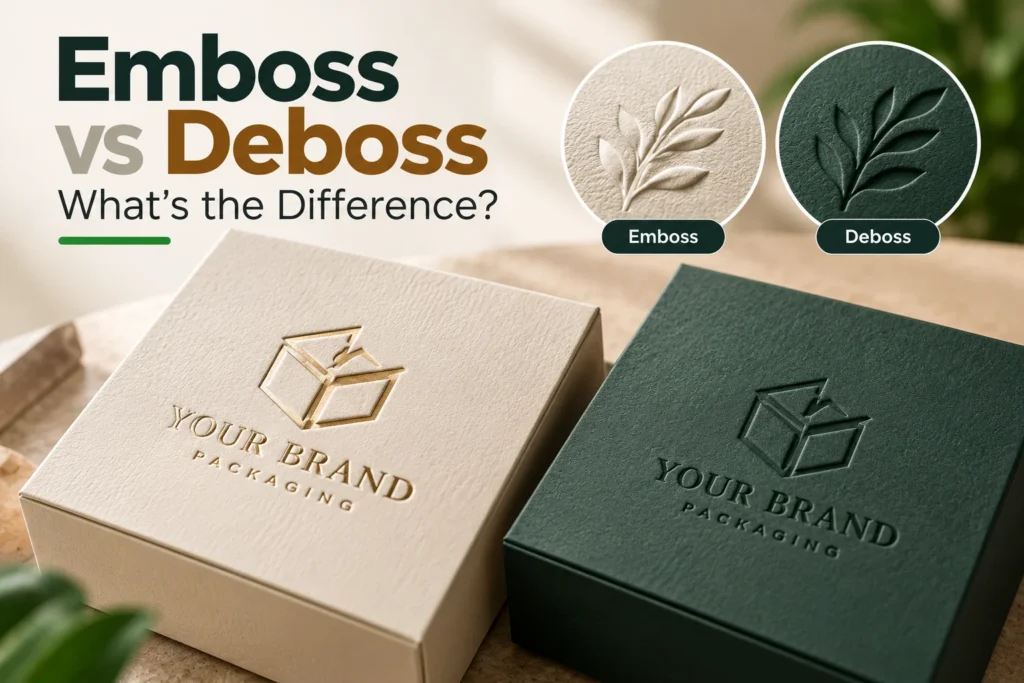
Embossing raises a design above the packaging surface. Debossing presses it below the surface. That is the main difference between emboss and deboss: one creates relief you can feel standing up; the other creates an indentation.
The choice affects more than appearance. A raised mark catches light differently from a recessed one, and the same artwork may need adjustments for each finish. The board, box construction and production setup matter too. Before choosing from a screen mockup, work out where the mark belongs and what you want someone to notice when they hold the box.
What Is Embossing?
An embossed design is formed by reshaping the material, leaving part of it higher than the surrounding surface. It is not simply a printed shadow or a separate piece glued onto the lid.
Think of a paperboard sleeve with a raised brand symbol. You can trace the symbol with a fingertip even if it uses the same color as the sleeve. A name, border or pattern can receive this treatment too. Great Little Box Company’s finishing glossary describes embossing as raising parts of a carton blank or sheet through pressure and tooling.
What Is Debossing?
A debossed design sits in a depression within the surface. The surrounding paper remains higher than the mark, so your finger moves into the impression rather than over a raised shape.
A small debossed logo on an otherwise plain box lid can make the branding noticeable through texture. Its visibility still depends on the material, lighting and design. Recessed does not automatically mean faint, and adding ink or foil can change the contrast considerably.
You may see the phrase “deboss printing” in a packaging brief. Clarify whether it means an uncolored impression, a recessed printed design or foil in the impression. Those are different specifications.
Emboss vs Deboss: The Main Difference
Raised vs Recessed Effect
Compare the finished face that the customer will see. The embossed part projects toward them; the debossed part sits farther into the material. Do not identify the finish from the reverse of a loose sheet, where a corresponding impression may be visible.
How the Die/Press Setup Differs
Embossing commonly shapes a sheet between a die and a matching counter-die. Their profiles create the relief. Debossing uses tooling arranged to produce the opposite surface result; its backing or counter arrangement depends on the job.
Avoid a blanket rule that debossing always needs only one tool or must therefore cost less. Ask how the supplier will achieve the specified impression on your actual packaging construction.
How Each Finish Feels and Looks
Raised edges can catch highlights and cast a small shadow outside the design. A recessed mark gathers shadow within its edges. Rotate a sample under ordinary room light. A finish that looks obvious in a carefully lit photograph may appear much quieter on a shelf.
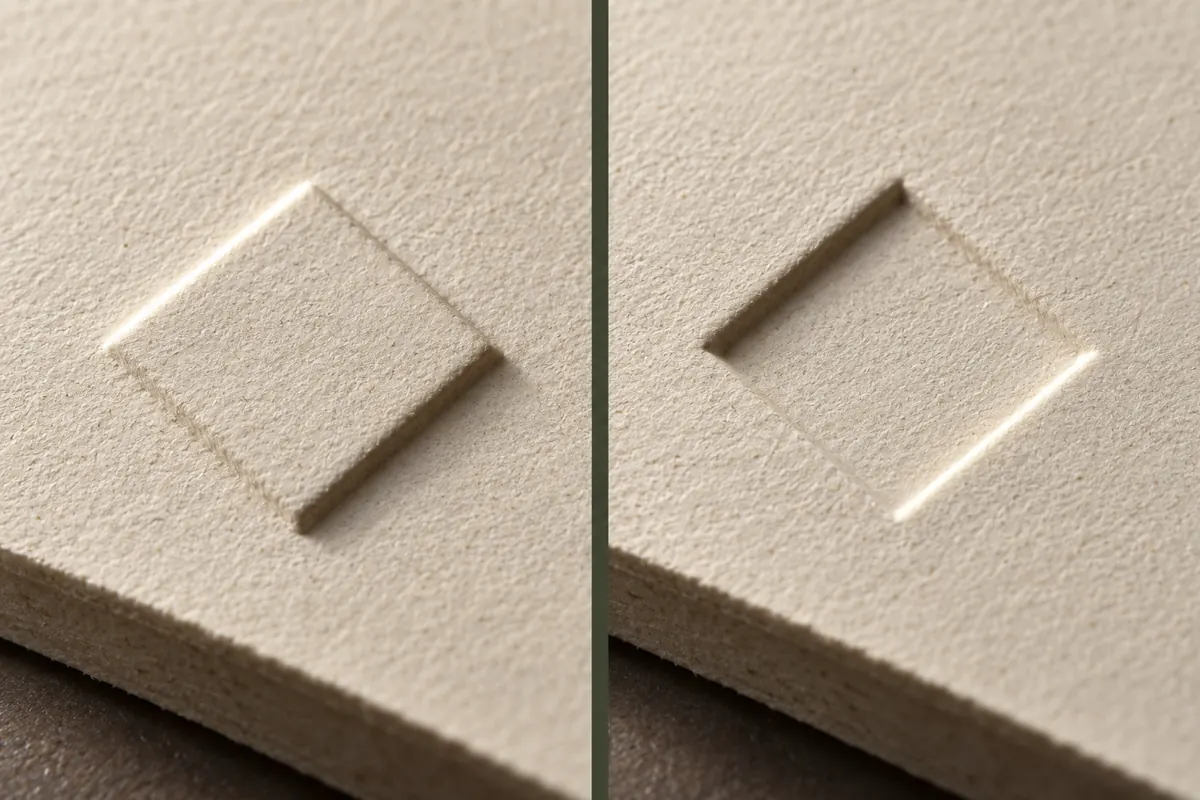
Embossing and Debossing on Custom Packaging
Logos are one application, but the finish can also define a product name, a small pattern or a border. Put the effect where it helps the design. A textured lid and a heavily decorated sleeve do not necessarily need the same treatment.
For custom rigid boxes, discuss the covering paper and the board underneath it. Finishing a wrap before assembly can be a different production route from pressing into an assembled construction. A thick finished wall does not tell you how the detail will be made.
On custom gift boxes, a central lid mark gives the finish room to be seen. Sleeves and presentation inserts offer other possible locations. With custom mailer boxes, confirm whether the proposed effect belongs on the outer liner, a separate sleeve or an insert; do not assume pressure can be applied without affecting the corrugated structure.
How the Embossing Process Works
The supplier reviews the artwork, stock and intended relief before tooling is made. A simple shape at one level and a sculpted design with several heights require different decisions.
The sheet is positioned between the tools, which are aligned to shape the selected area under pressure. Heat may be part of the process. The material is formed into relief rather than cut out. The diagram shows one simplified arrangement, with the customer-facing side upward.
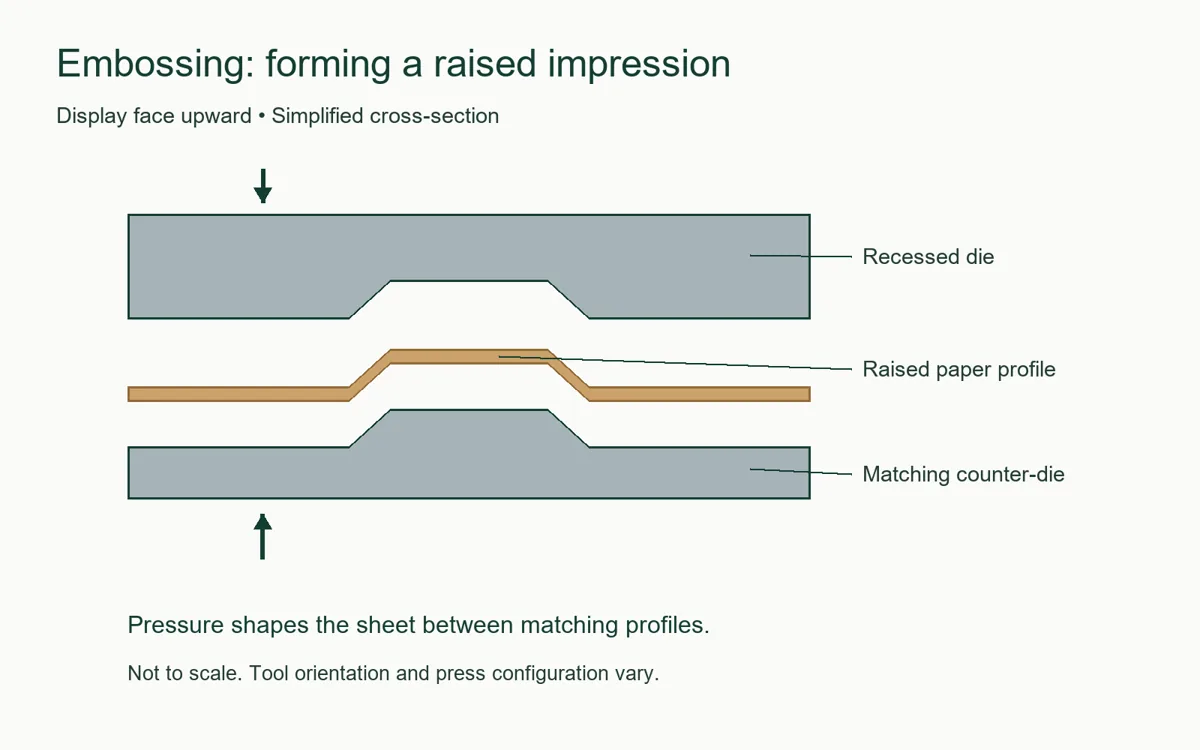
A proof on the specified stock lets you check the edge, depth and alignment before the full run. The press maker Kluge recommends proofing the die on the selected paper. A digital rendering can show placement, but it cannot tell you how the finished relief feels.
How the Debossing Process Works
Tooling presses the selected shape into the display face to create a recess. The operator controls the impression for the material and construction being finished. A deeper result is not automatically a cleaner one.
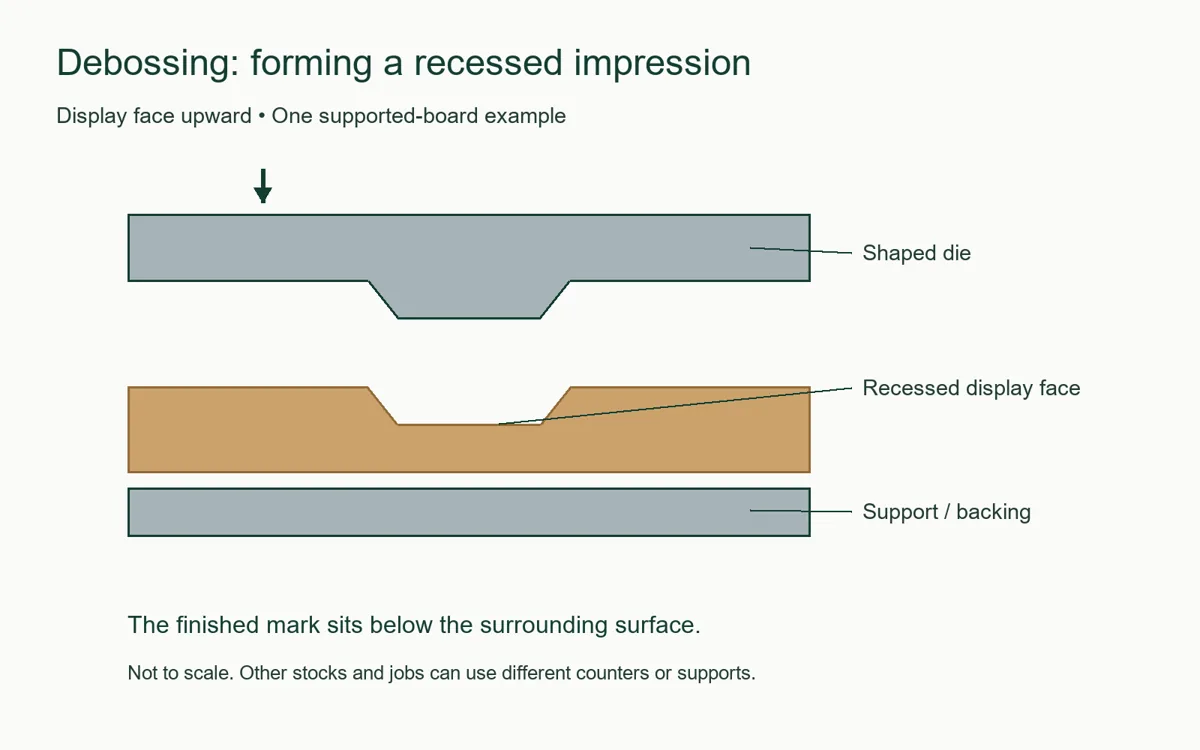
Check the opposite face where it will remain visible. A mark that looks tidy outside may affect the inside appearance of a thin carton. Wrapped or lined structures need their own assessment. Tell the supplier which surfaces the customer will see after opening, not just which panel faces forward in the artwork.
Embossed vs Debossed Logos
A useful comparison starts with the same logo, size and stock. Otherwise, you may be choosing between two different designs rather than comparing finishes.
Open shapes with clear spacing are easier to assess than a tiny symbol crowded by a tagline. Keep small reading text in print if the finishing sample cannot reproduce it clearly. There is no need to force the entire brand lockup into one impression.
For custom printed boxes, identify the relief on a separate artwork layer and show how it aligns with the printed logo. An offset edge may be intentional, but accidental misalignment usually looks like a production error. Review the closed box as well as the flat artwork: folds and panel proportions change the way a logo reads.
Which Materials Work Best?
Paperboard, cardstock and suitable covering papers are common starting points. Choose the exact stock with the finish in mind, including its surface and how it responds to forming. Thickness by itself is not a guarantee of a good result.
Holmen’s paperboard guide explains that the inner layers and surface must tolerate reshaping without cracking. A coated face, uncoated texture and laminated surface can each present different finishing conditions. Metsä Board’s examples also show why board and coating characteristics matter for detailed effects.
Request a sample of the proposed combination, not a different board that happens to be the same color. If the finish changes after stock selection, revisit the material approval.
Emboss vs Deboss: Cost, Durability, and Design Detail
The quote should account for artwork size, die complexity, setup, stock, quantity and any print or foil alignment. Ask for both options using the same box specification. Two totals are difficult to compare if one includes a different paper or an additional finishing pass.
Neither finish has a universal durability advantage. Raised areas can be exposed to rubbing or compression, while recessed areas can still suffer surface damage. The paper, finish depth, handling and packing arrangement all matter. Inspect the sample after representative packing and handling rather than treating a close-up photo as evidence of resistance to wear.
Fine lines and tight spaces deserve particular attention. Ask the finisher which details need opening up at the actual production size. There is no single minimum line width that suits every material and tool.
Blind Embossing and Blind Debossing
“Blind” means the impression carries no added ink or foil. The shape and the paper surface provide the effect. The rest of the box can still be printed; the term describes the treatment of that particular mark.
A blind impression can look quite different on smooth ivory paper and textured brown stock. View it in the conditions where the packaging will be used. If the brand name must be readable immediately, check that the relief provides enough contrast or keep a printed version elsewhere.
Can You Combine Embossing or Debossing With Foil?
Yes, where the selected material and production method support the combination. Foil supplies a surface effect; embossing or debossing supplies shape. Foil alone does not necessarily mean a mark is raised or recessed.
The operations can be separate, or suitable combination tooling can bring them together. Kluge’s explanation of combination work describes foil embossing in one press pass. Confirm the intended alignment and foil coverage with the supplier rather than assuming every foil-and-relief job follows that route.
Embossed or Debossed: Which Should You Choose?
Choose a raised treatment when the design calls for a mark that projects from the face. Consider a recess when an indented impression suits the artwork and how the package will be handled. Neither direction fixes weak artwork or unsuitable stock.
Before approving either option, answer four questions:
- Where should someone look or touch first?
- Does the smallest important detail remain clear at the final size?
- Is the reverse face visible when the box opens?
- Has the quoted material been sampled with the proposed finish?
For custom packaging boxes, send the box format, artwork, material preference and finish location together. That gives the supplier a usable brief instead of a request for “the deeper-looking one.”
Common Design Mistakes to Avoid
- Approving an enlarged logo only. Review it at the size that will appear on the box.
- Placing relief across a fold or closure without checking it. Mark panel boundaries on the artwork and ask about the available space.
- Treating depth as the goal. Clear edges and suitable relief matter more than the deepest possible impression.
- Ignoring the inside face. Open the sample and inspect any show-through or distortion.
- Leaving foil alignment until the end. Identify which printed, foiled and shaped areas must line up before tooling approval.
Quick Emboss vs Deboss Comparison
| What to compare | Embossing | Debossing |
|---|---|---|
| Surface effect | Design rises above the surrounding face | Design sits below the surrounding face |
| Visual character | Relief catches highlights and exterior edge shadows | Recess shows shadows within its edges |
| Tactile feel | Raised shape under the fingers | Indented shape under the fingers |
| Typical setup | Die and counter-die shape the relief | Tooling and support create the recess; setup varies |
| Material | Stock must form cleanly without surface damage | Stock and construction must accept the impression |
| Logo use | Raised symbol, name or pattern | Recessed symbol, name or pattern |
| Cost | Depends on tooling and complete job specification | Depends on tooling and complete job specification |
| Best fit | A design calling for raised prominence | A design calling for an indented treatment |
Frequently Asked Questions
What is the difference between embossing and debossing?
Embossing creates a raised design, while debossing creates a recessed one. They are opposite surface effects, but the exact tooling and production sequence depend on the stock and packaging construction.
What is embossing on packaging?
It is a finishing process that shapes a logo, text or pattern above the surrounding paper surface. The relief can remain uncolored or be coordinated with printing or foil.
What does deboss mean?
To deboss is to press a design into a surface so it sits below the surrounding area. A debossed logo is an indentation, not a raised badge or a printed shadow.
Which is better for a logo: embossed or debossed?
Choose based on the intended effect, logo detail, material and placement. Compare samples of the same artwork at the final size. Neither finish is automatically clearer or more suitable for every brand.
Is embossing more expensive than debossing?
Not in every case. Costs vary with tooling, artwork complexity, material, quantity and additional operations. Request comparable quotes rather than assuming the direction of the impression determines the price.
What is blind embossing or blind debossing?
It is a raised or recessed impression without ink or foil added to that mark. If foil is wanted instead, specify its coverage and alignment and confirm that the chosen stock supports the combined treatment.
KEEP EXPLORING