THE PACKAGING JOURNAL
Corrugated Flute Types: A, B, C, E & F Explained
Compare A, B, C, E and F flute profiles, separate flute height from board thickness, and understand the strength tests behind a packaging specification.
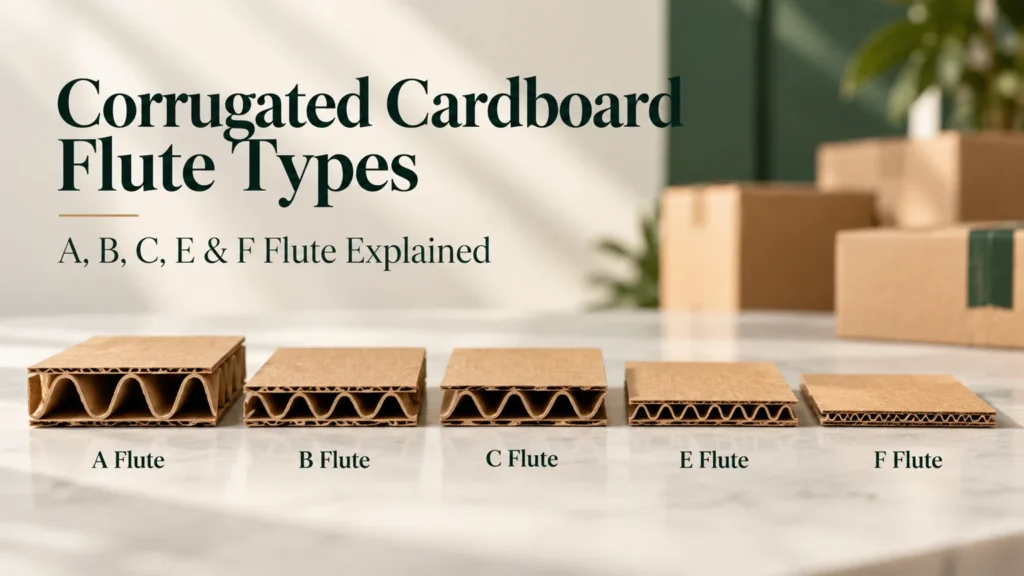
A corrugated cardboard flute is the wave-shaped paper layer between flat liners. A, B, C, E and F describe different profiles: taller waves generally provide more room for cushioning, while finer waves support a smoother printing surface. There is no single best flute for every box.
Start with the product and its journey. A printed retail carton, a parcel mailer and a stacked shipping case face different demands. Flute geometry helps narrow the options, but the complete board specification and finished-box testing establish performance.
What Is Corrugated Cardboard Flute?
Look at a cut edge of corrugated board. The flat sheets are liners; the shaped paper between them is the fluting medium. Together, these layers create a structure that separates the faces and resists bending.
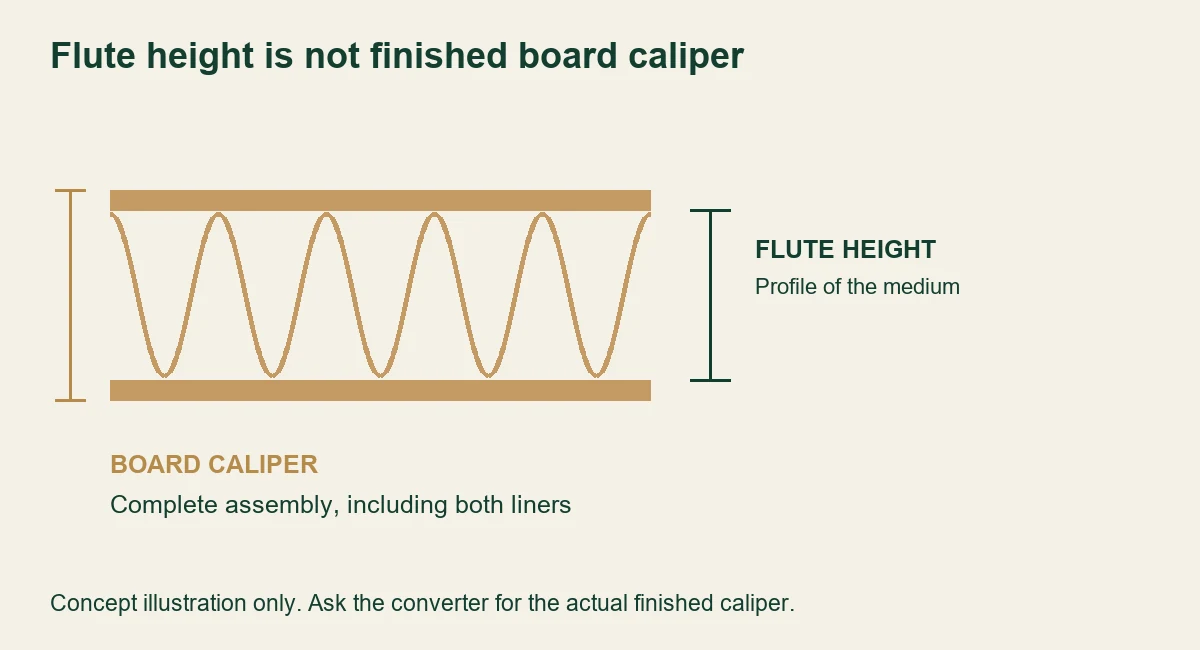
Three measurements often get mixed together. Flute height describes the corrugated medium’s profile. Flute count describes how many waves occur along a length. Finished board caliper measures the assembled material, including liners. None is a box’s internal dimension or a print-bleed allowance.
Our corrugated cardboard material page covers the buying options; this guide explains the profiles behind them.
Corrugated Flute Types at a Glance
The comparison uses two references: FEFCO’s indicative flute heights and the Fibre Box Association’s approximate flute counts. They are separate reference datasets, not a specification for one exact board.
Heights exclude facings/liners. FEFCO groups F, G and N together, so that row is not an F-only tolerance. Inch equivalents below are rounded.
Corrugated Flute Types Compared
| Flute | Indicative height | Approx. flutes/foot | Profile/surface | Common uses | Important note |
|---|---|---|---|---|---|
| A | 4.8 mm / 0.189 in | 33 | Tall, widely spaced | Cushioning pads; protective packs | Allow for bulk and converting |
| B | 2.4 mm / 0.094 in | 47 | Lower, closer-spaced | Die-cut boxes; partitions | Check finished caliper separately |
| C | 3.6 mm / 0.142 in | 38 | Mid-height, above B | General shipping cases | No fixed ECT rating |
| E | 1.2 mm / 0.047 in | 90 | Thin microflute | Printed mailers; retail packs | Protection needs validation |
| F | 0.5–0.8 mm / 0.020–0.031 in* | 125 | Very fine profile | Small retail cartons | *FEFCO’s grouped F/G/N range |
The featured image is illustrative, not a scale drawing or manufacturing specification. Profile heights and counts vary among producers; compare supplier samples and documented caliper.
A Flute: Thick Profile for Cushioning
A flute’s taller profile can be useful where cushioning space and board stiffness matter. Protective pads and some demanding multiwall constructions are possible applications. Its bulk also affects storage space, fold allowances and the final package size.
A thick section does not remove the need for internal supports. If a fragile item can strike the box wall, reconsider the complete pack rather than assuming taller fluting will absorb every impact.
B Flute: A Balance of Crush Resistance and Printability
B flute has a lower profile than C and more waves along a given length. Its closer support points can help with surface flatness and resistance to crushing across the board face. Die-cut cartons and partitions are common uses.
For B flute thickness, distinguish the 2.4 mm indicative medium height above from a converter’s finished board caliper. Added liners and manufacturing conditions change the assembled measurement. Specify which value is being quoted.
C Flute: Common General-Purpose Shipping Profile
C flute is a familiar starting point for general-purpose shipping cases. It sits between A and B in profile height, despite the alphabetical sequence. Its geometry can balance cushioning and structural needs in a transport carton.
That makes C flute corrugated board worth discussing for stacked shipments, but not automatically suitable for a particular load. Box size, board grade, closure, stacking pattern and storage conditions still need consideration.
E Flute: Thin Microflute for Print-Focused Packaging
E flute uses smaller, more closely spaced waves. A finer support pattern can reduce visible flute lines and suit detailed graphics on compact packaging. Printed mailer boxes and retail packs are useful applications to explore.
When asking for E-flute cardboard thickness in mm, request the finished board caliper. The 1.2 mm FEFCO example describes the medium without facings. Neither that figure nor a printed surface sample proves that the final mailer will withstand its delivery route.
F Flute: Fine Profile for Small Retail Packaging
F flute is a finer option for small retail cartons where compactness, folding and graphics matter. It can provide a corrugated construction with less bulk than larger profiles.
Compare a converted sample rather than judging by a flat sheet alone. The chosen paper, crease setup and closure affect how a small carton folds and stays square. A presentation pack may also need separate shipping protection.
Does Flute Type Determine Box Strength?
No flute letter has one universal ECT rating or shipping-weight limit. The profile is one part of a system that also includes liners, medium, adhesive bonding, wall construction, box geometry and converting quality.
Strength tests answer different questions. Edge crush testing (ECT) measures a board specimen’s resistance to edgewise compression. Box compression testing evaluates the assembled container under compression. Mullen/burst testing measures resistance to pressure-induced rupture; it is not the same as a puncture test.
Flute Profile vs Corrugated Strength Tests
| Factor/test | What it tells you | What is assessed | Determined by flute letter alone? | Why it matters |
|---|---|---|---|---|
| Flute profile | Wave geometry | Medium’s shape | Names a profile family only | Thickness and surface planning |
| ECT | Edgewise compression resistance | Board specimen | No | Board strength comparison |
| BCT / box compression | Container compression resistance | Assembled box | No | Stacking assessment |
| Mullen / burst | Pressure at rupture | Board specimen | No | A different strength property |
| Wall construction | Number of mediums and liners | Combined board | No | Structure and bulk |
Ask which test method, units and conditioning apply to a quoted result. A board rating cannot simply be read as the weight the finished box may carry. Moisture, joints, openings, flute direction and how boxes are supported can change performance.
How to Choose the Right Flute for Your Product
Give the supplier a practical brief before asking for a flute recommendation:
- Contents: packed weight, dimensions, fragility and any sharp or concentrated contact points.
- Handling: parcel delivery, pallet movement, repeated handling and likely crush or puncture exposure.
- Stacking: load above the bottom box, storage duration and how the stack is supported.
- Presentation: artwork detail, printing method, fold quality and opening experience.
- Environment: storage space, humidity exposure and expected transit conditions.
Then compare complete samples. A light printed retail set may justify discussing E or F flute. A transit case may lead to B, C or a double-wall option. These are starting points, not approved load categories.
For a jar or other fragile object, check how an insert restrains movement and supports the base. For flat products, look at bending and corner damage. Test the actual packed item when protection matters; an empty-box demonstration leaves out those failure modes.
Our custom box selection guide puts structure, fit and material choices together.
Single Wall vs Double Wall: When Flute Combinations Matter
Single wall has one fluted medium between two liners. Double wall has two mediums separated and faced by three liners. A finer outer profile can be paired with another profile to balance surface requirements and structural behavior.
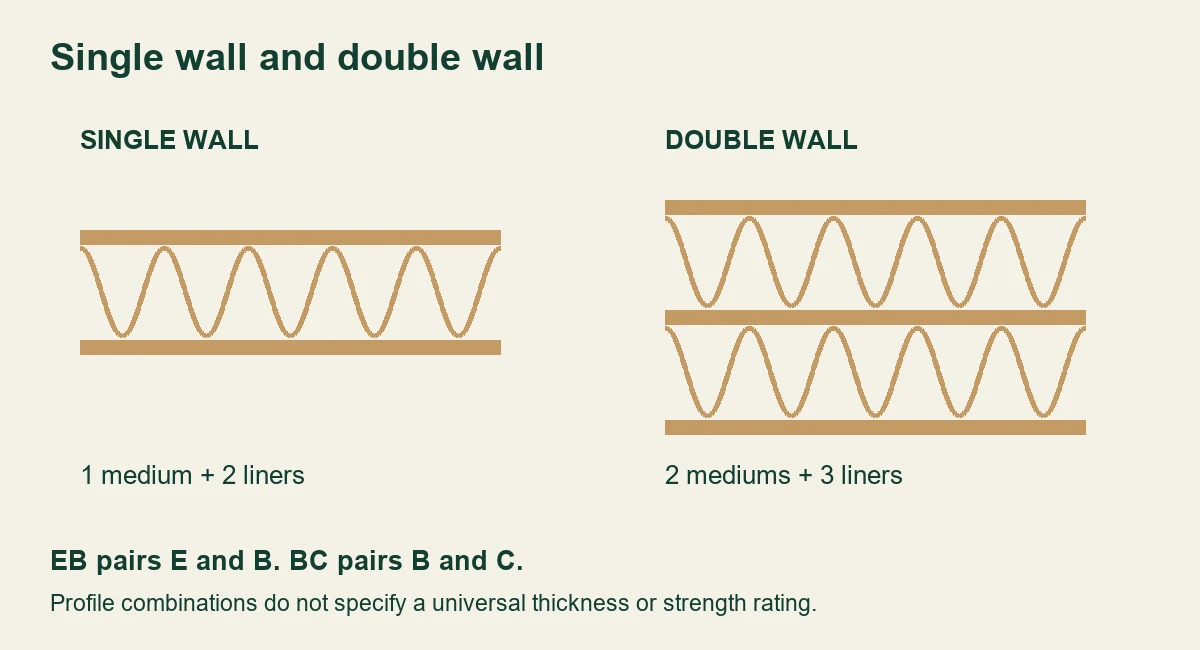
EB combines E and B; BC combines B and C. These letters identify the profiles, not a guaranteed finished thickness or strength grade. Confirm layer arrangement, caliper and test requirements with the converter.
Double wall may be worth evaluating when a single-wall trial lacks rigidity or protection. It also adds bulk and changes crease and loading allowances. Compare the complete proposal rather than assuming an extra medium always solves the problem.
Review corrugated box options against the actual load and packing arrangement.
Corrugated Printing, Dielines and Bleed
Fine flutes can support a smoother print face, but liner quality, press setup and printing process also affect the result. Ask for a printed sample when small text, solid colors or subtle flute lines matter. Our materials and finishes guide explains related choices.
The artwork file needs the converter’s approved dieline. Cut lines define edges; crease lines guide folds; glue areas identify bonding zones. Safe areas protect important artwork inside the cuts, while bleed extends backgrounds beyond them.
A printer might request roughly 3 mm of bleed, or specify 0.125 inch, which equals 3.175 mm. Follow the exact supplied requirement. Bleed is not flute height or board caliper. A FEFCO style code describes a box design; it does not replace a supplier-approved production dieline.
Frequently Asked Questions
What is the most common flute for shipping boxes?
C flute is widely used for general-purpose shipping cases. That makes it a useful starting point, but the required board grade, structure and testing depend on the shipment.
Is B flute or C flute stronger?
The letter alone cannot decide. B and C have different geometry, and the result depends on the papers, wall construction, finished box and type of loading being assessed.
How thick is E flute cardboard?
FEFCO gives an indicative E flute height of 1.2 mm excluding facings. Finished board caliper includes the liners and varies by specification, so request the converter’s actual measurement.
Is E flute suitable for mailer boxes?
It can be, particularly where compactness and graphics matter. Suitability still depends on contents, inserts, closure and delivery conditions; approve the finished pack after fit and protection checks.
Does C flute mean 32 ECT?
No. C describes the flute profile; ECT describes a measured board property. A supplier must state the actual strength specification rather than infer it from the letter.
When should I consider double-wall corrugated board?
Consider it when the complete packing assessment calls for more rigidity or protection than the proposed single-wall construction provides. Compare test results, fit, bulk and handling before approving it.
Choosing a Corrugated Board Specification
Record the flute profile, finished caliper, papers, wall construction, box dimensions and required testing together. For custom shipping boxes, include the packed product and its route. Share that brief with Custom Boxes Nation when requesting a packaging quote, then approve the sample and specification before production.
KEEP EXPLORING